- datapro.news
- Posts
- Is AI "Eating" Data Engineering Jobs?
Is AI "Eating" Data Engineering Jobs?
THIS WEEK: The layoff numbers are real. The AI narrative though is murkier. What does it mean for your career?

Dear Reader…
The headlines have been relentless. Amazon axed 16,000 corporate employees in January, with management pointing squarely at AI as the replacement. Meta followed in March, reportedly putting 15,000 roles (roughly a fifth of its global workforce) under review to offset spiralling AI investment costs. Dell shed 11,000 positions in a single quarter. Oracle announced sweeping cuts whilst simultaneously taking on debt to fund AI infrastructure.
By the close of Q1 2026, the US tech sector had recorded 52,050 layoffs, a 40% jump on the same period last year and the worst start to any year since 2023, according to executive coaching firm Challenger, Gray and Christmas. In March alone, AI topped the list of stated reasons for tech job cuts, accounting for 25% of all firings. A month earlier, that figure was 10%.
The trajectory is hard to ignore. But when you look past the headlines and interrogate the data, the story of what is happening specifically to data engineering careers becomes considerably more complicated and, in some respects, more interesting.
The "AI Smokescreen" Problem
Before we accept the narrative wholesale, it is worth pressing on the numbers. Research published earlier this year found that only around 5% of the 123,000 to 245,000 tech layoffs recorded across 2025 were directly attributable to AI automation. The majority of cuts, analysts concluded, were a hangover from the aggressive overhiring that followed the pandemic, when some of the largest tech firms ballooned their headcounts by 25 to 50% beyond sustainable levels.
A Harvard Business Review investigation published in January 2026 was unambiguous in its framing: Companies are laying off workers because of AI's potential, not its performance. The fear of being outcompeted by a leaner, AI-augmented rival is driving restructuring decisions that are then being packaged, publicly, as an AI story. It is a convenient framing. It signals forward-thinking strategy to investors whilst obscuring what is, in many cases, a mundane correction of previous excess.
That said, the trend line is shifting. In Q1 2026, 20.4% of all tech layoffs were explicitly attributed to AI, up from under 8% in 2025. Andy Challenger, chief revenue officer at Challenger, Gray and Christmas, put it plainly: "Companies are shifting budgets toward AI investments at the expense of jobs. The actual replacing of roles can be seen in technology companies, where AI can replace coding functions."
So the honest answer is that AI was not the primary driver of the last wave of cuts. But it is increasingly becoming the driver of the next one.
What Is Actually Happening to Data Engineers
For data engineering specifically, the picture diverges from the general tech narrative in important ways.
The role is not disappearing. It is undergoing a structural metamorphosis that is, depending on where you sit in the profession, either deeply threatening or genuinely exciting.
The traditional data engineer, the one who spent the majority of their week hand-crafting ETL pipelines, writing bespoke ingestion scripts and babysitting scheduled batch jobs, is facing real pressure. AI-assisted tooling now handles much of what constituted junior and mid-level data engineering work just two years ago. The "talent pipeline collapse" is already visible. Organisations are reporting difficulty filling entry-level positions not because the supply has dried up, but because the bar has risen so sharply that the traditional progression route no longer works. Firms want engineers who arrive AI-fluent from day one. Graduates who cannot demonstrate proficiency with agentic workflows and LLM-integrated tooling are finding the door much harder to open.
This is where the layoff data becomes most uncomfortable for early-career practitioners. The compression is real, and it is structural, not cyclical.
The Seniority Paradox
Yet something curious is happening at the other end of the career spectrum. Senior data engineers are, in many cases, being quietly rehired, brought back on contract or retained specifically to manage the technical debt that AI-generated pipelines are accumulating at pace. Globally, analysts estimate there are now 61 billion workdays' worth of technical debt in circulation, much of it spawned by AI systems producing code and data workflows that are functional but fragile, opaque and difficult to audit.
Someone has to understand the architecture well enough to validate what the machines are producing. Someone has to define the objectives clearly enough that the AI does something useful, not just something fast. That someone, increasingly, is the seasoned data engineer. It is worth noting that 72% of executives surveyed in 2026 now describe data engineers as integral business partners rather than back-office support. That is a significant shift in perception.
The practical implication is a career ladder that has had its lower rungs removed and its upper rungs reinforced. Data engineers who have accumulated five or more years of experience in schema design, distributed systems, data governance and real-time streaming architectures are commanding a premium. AI-specialised engineers are earning on average 14.2% more than generalist peers, whilst those with deep cross-domain AI fluency attract a wage premium of up to 56%.
What happens when the S&P moves 3% during your commute?
We are living in volatile times. While you cannot control the state of international affairs, you can position your portfolio accordingly.
Liquid is one of the fastest growing trading platforms, allowing users to trade stocks, commodities, FX, and more 24/7/365 from their phone and computer.
The Geography of Disruption
The geographic distribution of job gains adds another layer of nuance. The projected winners of 2026's net tech job growth are not the traditional Silicon Valley strongholds. Texas is forecast to gain over 32,000 tech positions, dwarfing California's 16,949. New York City and Dallas are leading metro gains. The shift reflects something structural. Legacy industries in finance, telecoms and logistics are embedding AI into their data infrastructure and need engineers who understand both the data layer and the business domain. Pure-play tech hubs are contracting whilst hybrid industry-tech talent markets are expanding.
For data engineers willing to move, or to reposition their skill set towards industry-specific domains, the opportunity landscape looks meaningfully different from what the headline layoff numbers suggest.
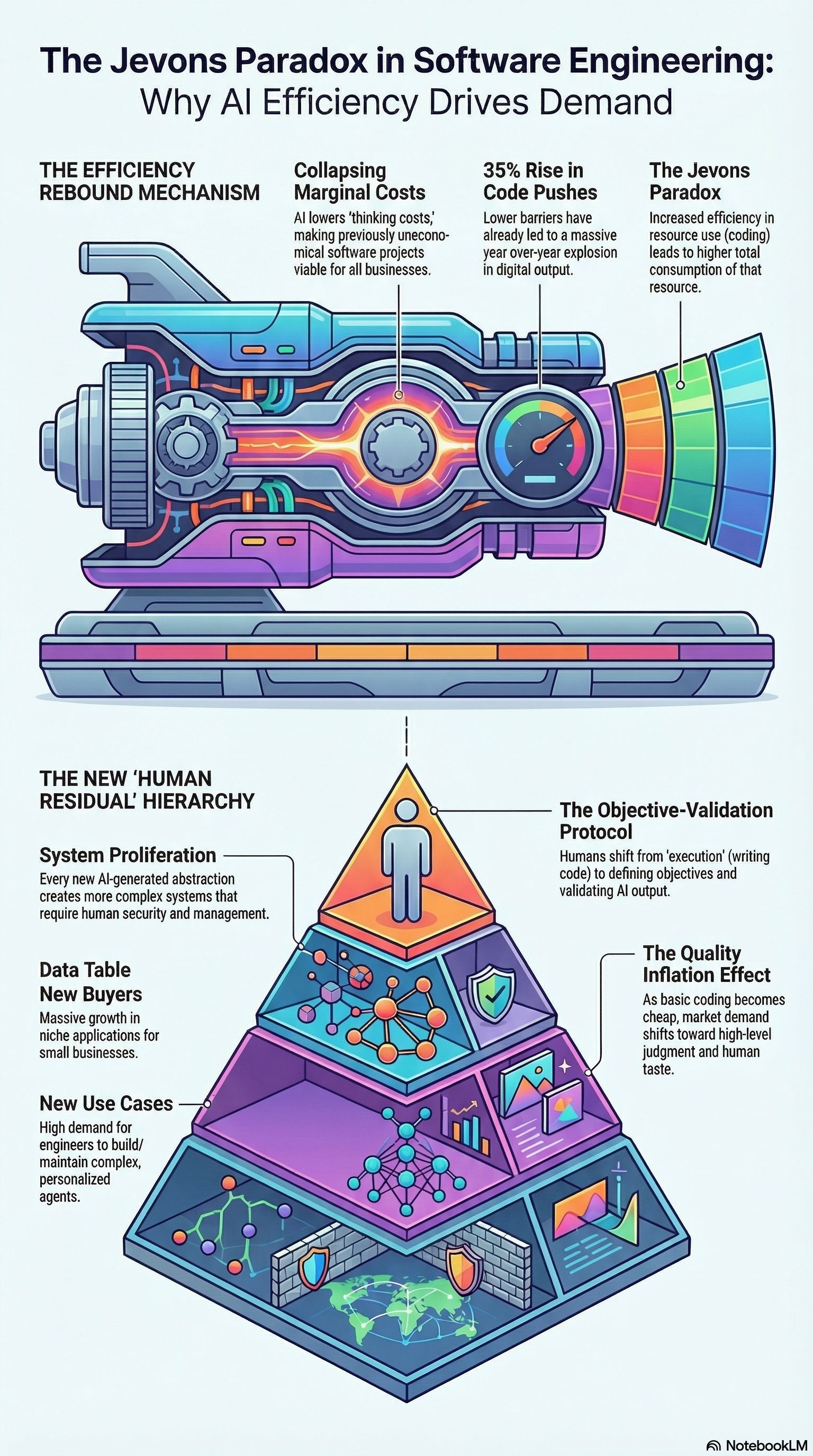
The Jevons Paradox Argument
There is a final thread worth pulling. Economists studying previous technology transitions point to the Jevons Paradox, the observation that efficiency gains from new technology tend to increase overall consumption of a resource rather than reduce it. Applied to AI and data engineering, the argument runs like this. As AI dramatically reduces the cost and complexity of building data pipelines, more organisations build them. More pipelines mean more data infrastructure, more governance requirements and more need for people who can design, oversee and evolve that infrastructure strategically.
The evidence is already emerging. GitHub reports a 35% increase in new software projects in 2026. New website creation is up 40%. The expansion of the digital surface area is accelerating precisely because building things has become cheaper and faster. If that logic holds, demand for skilled data engineers should grow even as AI absorbs the mechanical work that previously filled their days.
The critical qualifier is skilled. The jobs being displaced are execution-heavy and process-repetitive. The jobs being created reward architectural judgement, cross-functional fluency and the ability to define what "correct" looks like in a world where the machine does the building.

The Verdict
Is AI eating data engineering jobs? The honest answer, supported by the data available to us today, is that it is eating some of them, specifically the entry-level and process-heavy roles that formed the traditional base of the career pyramid. At the same time, it is expanding the strategic importance and compensation ceiling of the profession's upper tier.
What AI is unambiguously doing is compressing the timeline. The transition from junior pipeline engineer to strategic data architect, which might once have taken a decade of incremental experience, is now expected to happen faster, be more deliberate and be supported by a continuous investment in AI tooling literacy.
For practitioners watching this space, the data engineering job market in 2026 is not a story of extinction. It is a story of selection pressure and, for those positioned correctly, of genuine opportunity.